
The Weakness of the Islamic World in the Face of the Crusader Attacks
How disunity and corruption among the leaders of the Islamic world opened the door to the Crusader seizure of Nicaea and the Levant.
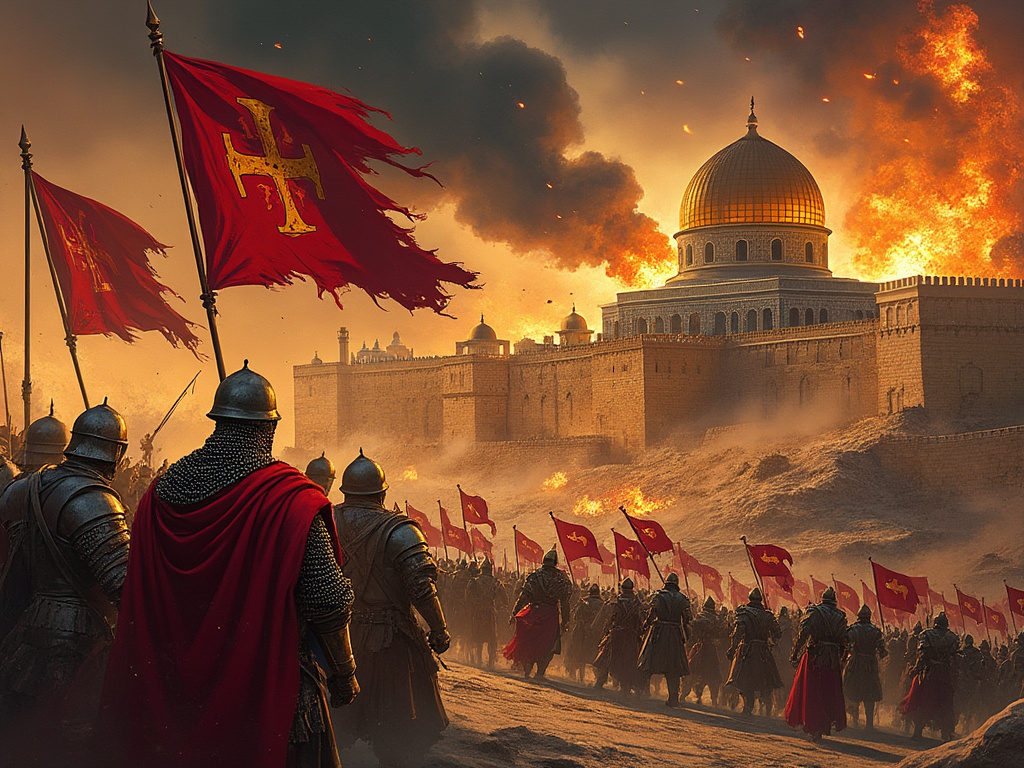
At a time when Islamic societies were suffering from corruption and weakness in various areas of life, and the leaders of the Islamic world were disunited and in conflict, the Crusaders attacked and overthrew the Seljuk ruler of Asia Minor, seizing their capital Nicaea. Then they descended to the Levant (al-Sham) and severely threatened the two princes, Ridwan in Aleppo and Duqaq in Damascus, forcing them to submit to the Crusaders and pay tribute. They accepted this humiliation to save their subjects and protect the sanctity of Muslim lands.[1]
The Crusader attacks increased and they seized vast territories. They captured Antioch in 491 AH / 1097 CE, and continued their advance until Jerusalem, which fell to them in 492 AH / 1098 CE. In every city or village they entered, they committed savage massacres and put their swords to work upon the population. Their horses waded through the blood of victims - men, women, and children. All this happened while Muslims were preoccupied with their own disputes and conflicts. The sultans and leaders did not take any action to stop this advance. The groups of the ummah remained busy with their petty affairs and trivial issues, competing and fighting over them.[2]
Historical Islamic sources provide ample, alarming images of the attitudes of rulers and Muslim groups, and their preference for their private matters over confronting the impending danger. Among these accounts is what Imam Ibn al-Jawzi mentioned in his history, Al-Muntazam, as well as Ibn al-Athir and others. When the Crusaders occupied Ramla, Jerusalem, and Asqalan, and slaughtered their inhabitants, killing in the courtyards of Al-Aqsa more than seventy thousand of its residents, scholars, students, worshippers, and ascetics.[3]
In the wake of these massacres, the people of the Levant (al-Sham) began appealing for help from the Abbasid Caliphate and the Muslims of the East. Ibn al-Athir and Ibn Kathir describe the departure of the delegation, how they were received, and the outcome, saying:
“People humiliatingly fled from al-Sham to Iraq, seeking help against the Franks from the Caliph and the Sultan. Among them was a delegation accompanied by the judge, Abu Sa’d al-Harawi. When the people of Baghdad heard of this terrible matter, it horrified them and they wept. Abu Sa’d al-Harawi composed a speech that was read in reception halls and on the pulpits, and people’s weeping increased. The Caliph urged the scholars (fuqaha) to go out to different lands to encourage their kings to wage jihad. Ibn Aqil and other notable scholars went out and travelled among the people, but it did not accomplish anything. Indeed, we belong to Allah and to Him we shall return.”
Abu al-Muzaffar al-Abyawardi composed these lines of poetry in an attempt to rally the Muslim masses:
We mixed our tears with blood that flowed,
So no target remained for the catapults.
The worst weapon a man has is a tear,
When war rages, faced with swords.
What is your response, O children of Islam?
Before you shelters have been trampled by hooves.
How can the eye sleep filled with slumber,
Over atrocities that have awakened every sleeper?
While your brothers in al-Sham can only nap,
On the butcher’s block or in bellies of beasts.
The Franks stamp them with dishonour,
And you shuffle along pleasant life in total peace.
Whoever saves himself, absent of war’s adversities
Saves himself to be visited by the old age of regret.
As if the Messenger shrouded in Madinah shouts
Out with all his strength, ‘O House of Hashim (Abbasids)!
I see my nation not raising their spears against the enemy,
And the religion’s pillars, they shake flimsily.’
They avoid the fire fearing death,
But do not consider dishonour a deadly blow
Are Arab heroes content with injustice,
While foreign knights ravage their dignity?
If only, since they did not defend religion zealously,
They had at least jealously guarded what is sacred.
If they abstained from heavenly reward when battle raged,
Will they not at least seek out its worldly spoils?
Ibn Taghri Bardi narrates that another poet said:
Disbelief has inflicted upon Islam a tyranny,
Over which religion will long lament.
A right is lost and a sanctuary violated,
A sword is cutting and blood is spilling.
How many Muslims have become captives,
Muslim women have had their honour robbed.
Matters which, if a child contemplated,
Would turn his drooping hair grey.
Are Muslim women taken captive at every frontier,
Yet then, does Muslim life remain pleasant?
Tell those of insight wherever they are:
Answer Allah’s call, woe to you, answer!
Ibn Taghri Bardi adds that other poets and orators continued to try and rouse a response, meeting with official and public bodies but without result. He commented on this outcome saying: “The point is that the judge and his companions returned from Baghdad to al-Sham without any help. There is no power or strength except with Allah.”[4]
The Islamic sources present us with uglier images of the caliphs’ and sultans’ inaction in the face of the atrocities committed by the Crusaders in Jerusalem and the coasts of Syria and Lebanon. One of the delegations seeking help brought a large sack full of skulls and hair of women and children and scattered them before the officials. The caliph’s response to his minister was:
“’Leave me be, I am busy with something more important than this! I haven’t seen my spotted pigeon for three nights.’ The caliph had a spotted pigeon trained as a champion pigeon fighter. This was a common hobby among people, and the caliph was particularly fond of it, as were the wealthy and upper classes.”
In the same year that disaster struck the holy city, the three Seljuk sultans and sons of Malik Shah, that is Muhammad, Sanjar, Barkiyaruq, were fighting for influence and power. In Dhul al-Hijjah of that year, Muhammad entered Baghdad and gave a sermon there, then went to Rayy (in modern day Iran) where he found Lady Zubaydah, the mother of his brother Barkiyaruq, and ordered her strangled. At the same time, he fought his brother Barkiyaruq in five huge battles.[5]
Extracted from our upcoming publication, ‘This is how the Generation of Salahudeen Appeared and Jerusalem Re-captured**’**, Dr. Majid Arslan Kilani.
[1] Nur al-Din Mahmud, Dr. Hussein Mu’nis
[2] Al-Bidayah wa al-Nihaya, Ibn Kathir
[3] Diwan al-Mubtada’ wa al-Khabr, Ibn Khaldun
[4] Al-Nujum Al-Zahirah, Ibn Taghri Bardi
[5] Al-Bidayah wa al-Nihaya, Ibn Kathir
Originally published on the Dhikr Substack.